

Why You Won’t Find Wild-Foraged Mushrooms in Golden Hourglass Teas
Introduction
Within the mycology community, conversations around harvesting wild mushrooms can easily turn contentious, often touching on "pick shaming." To be clear, I do not believe in shaming anyone for their personal, respectful relationship with foraging. However, building a commercial, nationally distributed business on wild-harvested fungi is a completely different story. Ethical business ownership requires clear boundaries, and when scaling a brand, my choice as a tea maker is simple: I vow to source from farms and agricultural producers.
Before diving into why I formulate exclusively with cultivated varieties, I want to pause on the concept of "wild" itself, because it carries deep philosophical weight. In wellness marketing, "wild" is often thrown around as a shorthand for purity or vitality. But historically, "wilderness" has also been used to distance people from the land, framing nature as something untamed, separate from humanity, or waiting to be extracted. In an era of rapid environmental degradation, clinging to this romanticized view of wilderness risks blinding us to what conservation actually requires. Examining our language opens up a kinder, more inclusive space. The space that shifts us away from extraction and toward true stewardship: preservation, restoration, and a genuine, reciprocal relationship with the land and the medicinal fungi growing upon it.
When we look closely at natural environments, we see that fungi hold specific ecological roles essential to planetary health. Most medicinal species are saprotrophic decomposers, breaking down dead organic matter to build rich, living soil. Others form mycorrhizal networks, weaving symbiotic relationships directly with tree roots to share nutrients across entire woodlands. Understanding these delicate roles down to the species level clarifies why unmanaged forests cannot serve as open-air storehouses for commercial gathering. While personal foraging can be a beautiful way to ground oneself in a landscape, scaling a product line on wild-harvested mushrooms asks far more of these ecosystems than they can sustainably give. Responsible stewardship means honoring those boundaries and protecting the integrity of wild spaces so fungi can do their vital ecological work. I am betting on intentional, organic cultivation to build a more sustainable path forward for functional wellness.
Ecological Stewardship and Sustainable Cultivation
Wild fungal networks serve as vital infrastructure for forest ecosystems, driving nutrient recycling, supporting tree communication, and maintaining soil micro-communities. Stripping these macrofungi to support commercial production puts unnecessary pressure on fragile wild habitats.
Fortunately, cultivated mushrooms offer an extraordinary alternative. According to agricultural life-cycle assessments, cultivated fungi are among the most resource-efficient crops on Earth. They require minimal land and water, feature rapid growth cycles, and allow farm operations to adapt with precision. By choosing cultivated functional mushrooms, we practice true environmental stewardship, meeting human wellness needs while leaving wild forests untouched.
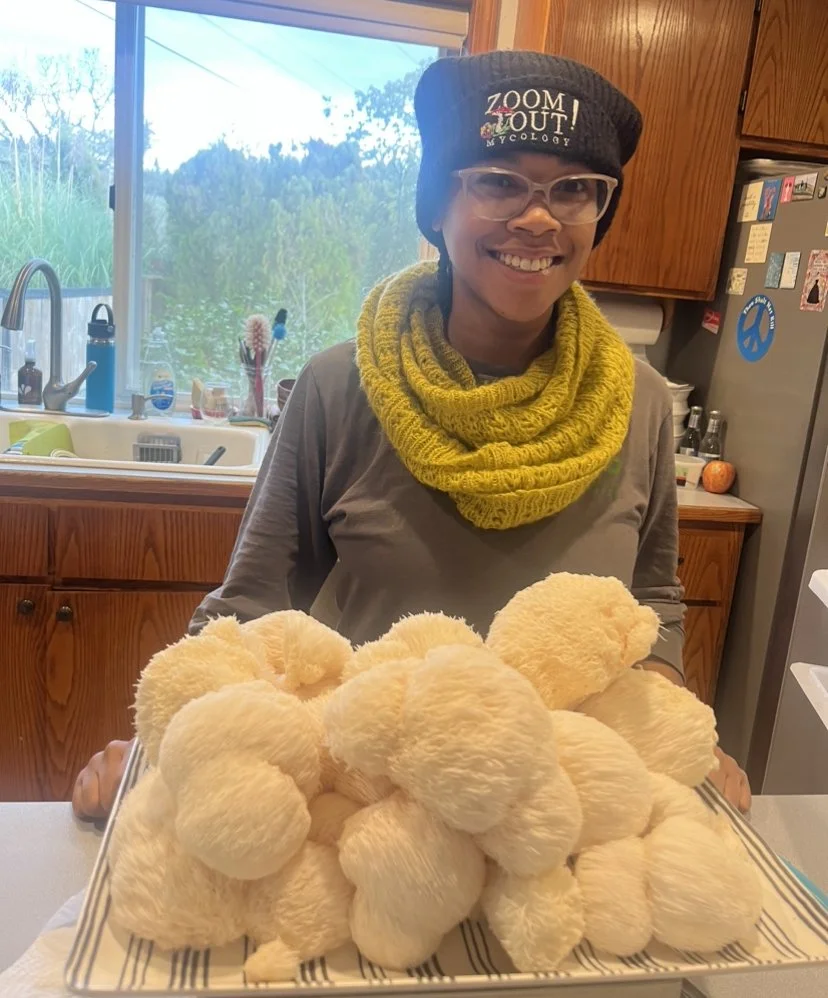
Circa 2021 at my farm in Springfield, Oregon. (I am not currently farming as of fall/winter 2026 and 2027).
A Quick Note on Cultivation Systems: While widely cited agricultural sustainability metrics often reference secondary and tertiary compost decomposers like button mushrooms (Agaricus bisporus), functional wood-decay fungi—such as Reishi, Lion's Mane, and Shiitake—operate on distinct wood-based substrates (like hardwood sawdust or logs). Nevertheless, both cultivation systems share the same core benefit: exceptional land and water efficiency that removes commercial harvesting pressure from native ecosystems.
The Substrate Reality: Controlling Potency, Purity, and Extraction
Beyond ecological considerations, sourcing mushrooms for a functional loose-leaf tea line demands scientific consistency. Fungi are powerful bioaccumulators; their mycelial networks absorb chemical compounds, nutrients, and heavy metals directly from their immediate environment. In unmonitored forest soils, wild mushrooms absorb whatever surrounds them, resulting in unpredictable heavy metal profiles, soil grit, micro-insects, and inconsistent moisture levels that compromise shelf-life stability and hot water decoctions.
A common misconception among consumers is that wild fungi are inherently "more potent" than cultivated ones. However, applied mycology and peer-reviewed studies reveal a different reality:
Targeted Metabolite Synthesis: Research on medicinal cultivars like Ganoderma lucidum (Reishi) demonstrates that primary bioactive metabolites—such as ganoderic acids (triterpenes) and immunomodulatory -glucans (polysaccharides)—are heavily dictated by the carbon-to-nitrogen ratio and specific wood/agronomic substrate recipes used during cultivation.
Enhanced Antioxidant Yields: Comparative studies show that optimizing growth media with natural lignin and mineral sources can increase total polyphenols, flavones, and targeted antioxidant capacity by upwards of 30% to 40% compared to unmanaged wild growth.
Safety and Batch Consistency: Sourcing from certified organic farms better ensures clean growing media, rigorous and recurring heavy metal testing, and zero contamination. Controlled dehydration ensures exact moisture percentages, eliminating grit and variance so that every pot of tea yields a clean, reliable, and effective decoction.
Global Agricultural Wisdom and Education as Preservation
Choosing cultivated fungi also allows us to embrace thoughtful global sourcing. Rather than forcing local wild environments to meet commercial demand, we trust experienced agricultural systems in regions where these crops have been cultivated natively for centuries. Cultivation is not an artificial shortcut; it is a discipline honoring generations of farming mastery and traditional agricultural wisdom. Partnering with these established growers enhances both crop quality and global accessibility.
Ultimately, my goal as a tea maker and applied mycologist is simple: to contribute to the preservation of wild nature through education. By choosing cultivated mushrooms for every blend, we offer a safe, potent, and sustainable product, protecting wild ecosystems while nourishing the communities we serve.
Sources:
Mkhize, S. S., Cedric Simelane, M. B., Mongalo, I. N., & Pooe, O. J. (2022). The effect of supplementing mushroom growing substrates on the bioactive compounds, antimicrobial activity, and antioxidant activity of pleurotus ostreatus. Biochemistry Research International, 2022, 9436614. PubMed Central. https://doi.org/10.1155/2022/9436614
Pilz, D., & Molina, R. (1996). Managing forest ecosystems to conserve fungus diversity and sustain wild mushroom harvests. https://doi.org/10.2737/pnw-gtr-371
Robinson, B., Winans, K., Kendall, A., Dlott, J., & Dlott, F. (2018). A life cycle assessment of agaricus bisporus mushroom production in the USA. The International Journal of Life Cycle Assessment, 24(3), 456–467. https://doi.org/10.1007/s11367-018-1456-6
Rózsa, S., Măniuțiu, D.-N., Poșta, G., Gocan, T.-M., Andreica, I., Bogdan, I., Rózsa, M., & Lazăr, V. (2019). Influence of the culture substrate on the Agaricus Blazei Murrill mushrooms vitamins content. Plants, 8(9), 316. https://doi.org/10.3390/plants8090316
Sissi Wachtel-Galor, Yuen, J., Buswell, J. A., & Iris. (2011). Ganoderma lucidum (Lingzhi or reishi). CRC Press/Taylor & Francis. Nih.Gov. https://www.ncbi.nlm.nih.gov/books/NBK92757/
